


No wheel tracks.
More ways into the field.
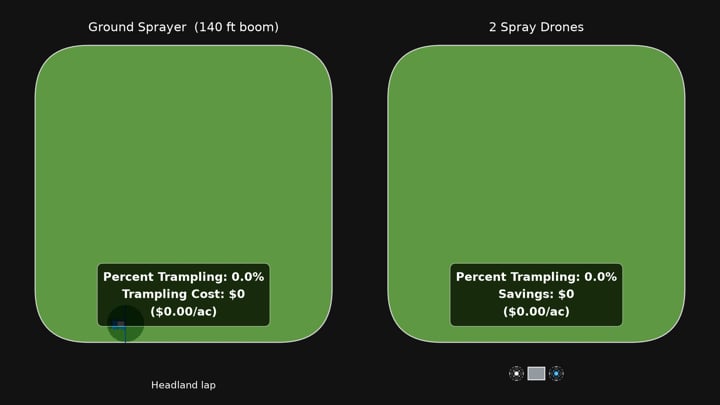
A ground pass through 45 bushel canola costs you $15 to $31 an acre in crop you never combine. We fly it for $16 an acre and drive over nothing.
Custom drone application reaches wet, rough, and awkward fields without putting a heavy sprayer through them, and without you buying, licensing, and staffing a drone program yourself.
The numbers don't lie
The hidden cost of ground application
Every pass your sprayer makes, it also drives on. Wheel tracks, headland turns, and compaction take out 2 to 4 percent of the field. On 45 bushel canola at $16.95, that's $15.30 to $30.60 per acre, per pass, gone before the combine reaches it.
At 3 percent, the damage alone exceeds what we charge to do the job.
Beyond the standing crop: no ruts to work around next spring, and no compaction quietly costing you root depth for seasons afterward.
Apply when ground equipment can't
Hiring an operator is simpler than buying, licensing, staffing, mixing, and flying a drone yourself. You keep control of the agronomy. We handle the operational complexity.
Wet fields and tall crops
Fly the morning after rain, while a ground rig is still waiting for the field to carry weight. Late-season fungicide on headed cereals or flowering canola goes on without knocking the crop down.
Rough pasture and rangeland
Custom operators turn down pasture with rocks, brush, washouts, and coulee sides, for good reason. LiDAR terrain following holds spray height over ground a boom can't follow, and there's nothing to get stuck.
Odd shapes and problem patches
Corners, fencelines, sloughs, isolated patches. We map first and treat what actually needs treating, instead of forcing a 120-foot boom through a tight approach or blanket-spraying a whole quarter to kill patches on fifteen percent of it.
Peak capacity
When the window is five days wide and your own rig is maxed out, we take the acres that would otherwise go on late or not at all.

What you get
Licensed and insured. Advanced RPAS Pilot Certificate (Transport Canada), Saskatchewan pesticide applicator certification, and commercial liability coverage. Health Canada approved drone pesticide application on June 30, 2026 under SPN2026-02.
Full digital coverage maps delivered after every job, showing exactly where product went and at what rate. Useful for your records, your agronomist, and your own peace of mind.
LiDAR point-cloud survey data available on request: terrain models, drainage assessment, and canopy mapping from the same flights.
You supply the product. We apply what you and your agronomist have already decided on, at your rate, to label. No markup on chemical, no pressure to buy through us.

Welcome to Precision Agriculture
Stop paying to spray dirt.


Blanket spraying treats your whole field like it has the same problem. It doesn't.
Kochia sits in patches. Wild oats cluster in the low spots. Disease pressure starts on the north-facing slope and the slough edges. But a ground rig can't tell the difference, so you pay full rate across every acre to kill weeds on maybe fifteen percent of them.
We map first, then spray. A survey flight builds a centimetre-accurate weed and canopy map of your field before a single drop goes out. Then the drone flies that map, turning nozzles on over the patches and off over clean crop. On a typical quarter with scattered kochia, that's 60 to 80 percent less chemical on the same acres, and the problem areas get hit at a full lethal rate instead of a compromise rate stretched across the whole field.
That cuts both ways on your bottom line. Less product in the tank on a $40-an-acre herbicide is $24 to $32 an acre saved. And the patches that used to survive a watered-down blanket pass, the ones that seed out and come back worse every year, actually die.
Resistant weeds don't spread because you sprayed too little. They spread because you sprayed everything at a rate that only killed the weak ones. Targeted application breaks that cycle.